

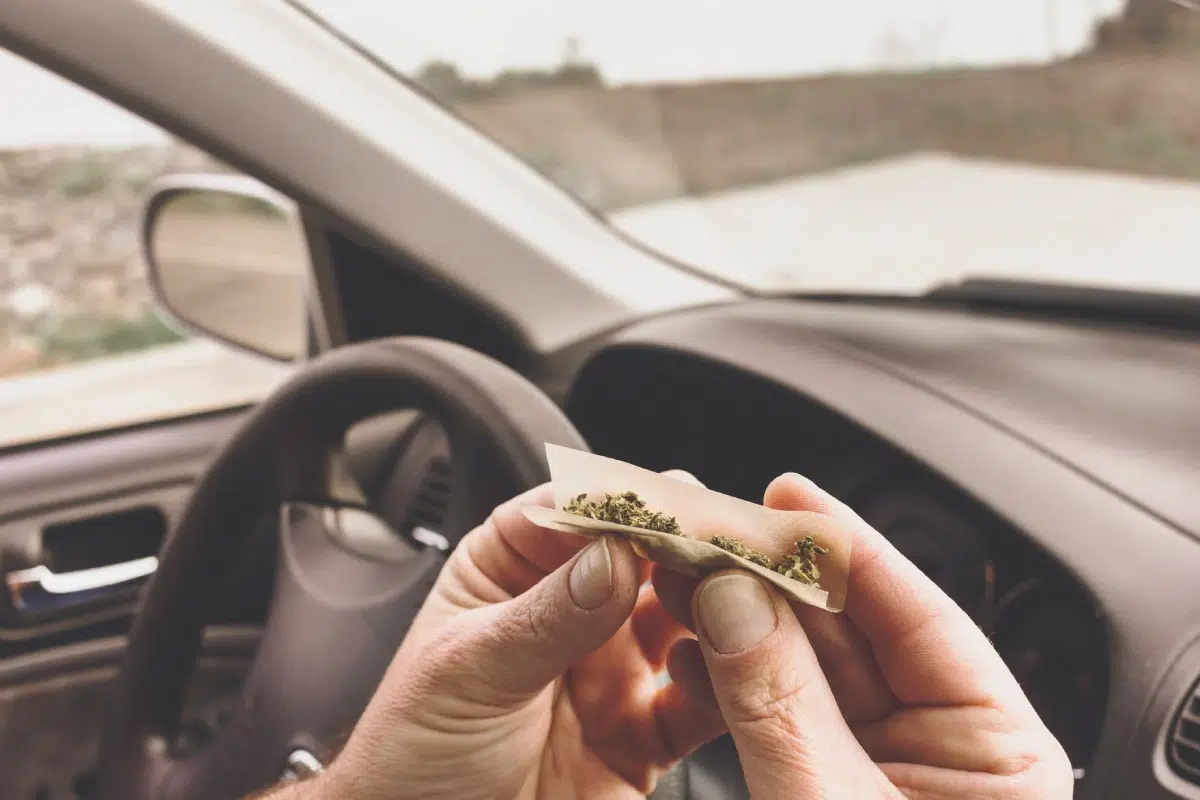



Seeing flashing blue lights in your rearview mirror is a heart-stopping moment for any driver. But if you have consumed cannabis recently, that anxiety is often compounded by confusion about whether you could be accused of driving under the influence. With alcohol, the rules seem clear: there is a breathalyzer, a .08 limit, and a standard procedure. With marijuana, however, the rules feel hazier. Drivers often ask us, “How do cops test for weed DUI when there is no breathalyzer for drugs?”
The reality is that policing cannabis impairment is far more subjective and complex than policing alcohol. In Fairfax and across Northern Virginia, law enforcement relies on a combination of old-school observation, flawed field tests, and invasive chemical testing to build a case against you. Unlike alcohol DUIs, there is no fixed THC limit to determine impairment, making marijuana DUI cases more complicated. This means that proving impairment relies heavily on officer observations and subjective assessments rather than a clear chemical threshold. Understanding these methods is critical because they are not infallible. In fact, they are often prone to error, bias, and scientific inaccuracy.
At Scott C. Nolan, we have spent years dismantling these cases. Whether you need a robust DUI defense strategy or a dedicated marijuana DUI lawyer to challenge the specific evidence against you, knowledge is your first line of protection. In this guide, we will pull back the curtain on how police test for marijuana DUI in Virginia, where the system fails, and how we fight back.
Observational Techniques During Traffic Stops
Long before a chemical test is ever proposed, the officer is building a case against you based on observation. In the world of DUI enforcement, this is often divided into three phases, the first two of which are entirely observational: “Vehicle in Motion” and “Personal Contact,” both of which typically occur during a traffic stop.
During these phases, officer observations play a crucial role. Officers look for visual and behavioral indicators such as erratic driving, bloodshot eyes, slowed speech, or the smell of marijuana. These officer observations are subjective but are critical in identifying suspected marijuana impairment.
These observations are used to establish reasonable suspicion, which is the legal threshold required for officers to proceed with further testing or investigation.
Assessing Driving Behavior
The investigation begins the moment an officer spots your vehicle. Unlike alcohol, which often leads to aggressive speeding or wild weaving, marijuana impairment often manifests differently—or sometimes, not at all. Officers are trained to look for signs of impaired driving and “drugged driving,” which might include driving excessively slowly, failing to respond to traffic signals, or weaving within a lane.
A traffic violation is a common reason for initiating a stop. However, many of these behaviors are also indicative of a tired driver, a distracted driver, or simply a nervous one. In Fairfax, where traffic congestion is the norm, “erratic driving” can often be explained by confused navigation or sudden lane closures. Yet, if an officer suspects drugs, innocent driving errors are quickly relabeled as “pre-arrest screening indicators.”
The “Personal Contact” Phase
Once you are pulled over, the officer transitions to face-to-face observation. This is where the marijuana odor as evidence comes into play. While Virginia law has evolved regarding whether the odor of cannabis justifies a vehicle search, officers still use the smell of burnt or fresh marijuana as a primary building block for a DUI investigation. They will claim that the odor, combined with other signs, gave them probable cause to suspect impairment.
Beyond smell, officers are scrutinizing your physical appearance. They are looking for:
- Bloodshot or glassy eyes: A common side effect of cannabis, but also a common side effect of allergies, fatigue, or staring at a computer screen all day.
- Dilated pupils: Officers may shine a flashlight in your eyes to check for pupil size and reaction to light.
- Speech patterns: While alcohol typically causes slurring, cannabis is often associated with slow, deliberate speech or a dry mouth (cottonmouth).
- Slowed reaction times: Officers may note delayed responses to questions or instructions as a behavioral indicator of marijuana impairment.
- Motor skills: Impairments in coordination and balance are also assessed, as marijuana can affect a person’s motor skills during the personal contact phase.
It is important to remember that these observations are subjective. One officer’s “slow, confused speech” is another person’s “thoughtful, careful response.” When we review dashcam footage during a Virginia cannabis DUI defense, we often find that the officer’s report exaggerates these behaviors to fit the narrative of impairment.
Field Sobriety Tests (FSTs) for Marijuana
If an officer suspects you are under the influence, they will likely ask you to step out of the vehicle for Standardized Field Sobriety Tests (SFSTs). These tests are a critical part of the Fairfax marijuana DUI testing process, aimed at determining marijuana impairment. Officers use SFSTs to assess impairment in suspected drivers.
The Three Standard Tests
The National Highway Traffic Safety Administration (NHTSA) has standardized three tests for DUI detection:
- Horizontal Gaze Nystagmus (HGN): The officer asks you to follow a pen or light with your eyes. They are looking for involuntary jerking of the eyeball (nystagmus). These tests are primarily designed to detect alcohol impairment.
- Walk-and-Turn: You are asked to walk nine steps, heel-to-toe, turn, and walk back.
- One-Leg Stand: You must balance on one foot while counting aloud.
Here is the problem: Are field sobriety tests reliable for marijuana? The science suggests they are not. The HGN test, which is the most scientifically relied-upon test for alcohol, is largely ineffective for cannabis. Marijuana generally does not cause Horizontal Gaze Nystagmus. If an officer claims you failed the eye test and therefore must be high on weed, they are either mistaken or misrepresenting the science.
The Walk-and-Turn and One-Leg Stand test balance and divided attention (the ability to follow instructions while performing a physical task). While heavy cannabis use can affect balance, many sober people fail these tests due to nervousness, age, weight, or poor roadside conditions (like gravel or uneven pavement). When officers interpret failed tests, proving impairment from marijuana is challenging because these methods were developed for alcohol and rely on subjective observations rather than a clear THC threshold.
Additional “Non-Standard” Tests
Recognizing that standard tests often fail to detect marijuana impairment, officers may employ non-standardized tests for the purpose of detecting marijuana impairment. A common one is the Modified Romberg Balance Test. In this test, you are asked to close your eyes, tilt your head back, and estimate when 30 seconds have passed.
The theory is that cannabis alters time perception, causing users to count too fast or too slow. Officers also look for eyelid tremors or body swaying during this test. Because these tests are not fully standardized like the big three, they are even more subjective and open to attack in court.
The Role of Drug Recognition Experts (DREs)
In Fairfax and other well-funded jurisdictions, if a patrol officer suspects drug impairment but the alcohol breath test comes back zero, they may call in a Drug Recognition Expert (DRE).
It is crucial to have a defense attorney with a deep understanding of DRE protocols and the science behind drug impairment to effectively challenge DRE testimony in marijuana DUI cases.
What is a DRE Evaluation?
A DRE is an officer with specialized training in recognizing the physiological signs of different drug classes. The drug recognition expert evaluation is a 12-step process that usually takes place at the station or jail. Its purpose is to determine whether the driver is under the influence of marijuana or other substances. It includes:
- Detailed checking of pulse rates and blood pressure.
- Examinations of pupil size in different lighting conditions.
- Checking muscle tone (rigid vs. flaccid).
- Looking for injection sites (mostly for other drugs).
- Interrogation regarding drug use.
Challenging the “Expert”
While the title “Expert” sounds intimidating, DREs are police officers, not toxicologists or doctors. Their conclusions are based on a matrix of symptoms that can often be caused by medical conditions or stress. For example, a high pulse rate (tachycardia) is a sign of cannabis use, but it is also a sign of being arrested and terrified.
We frequently challenge DRE testimony by highlighting alternative explanations for the physical symptoms observed. If how police prove impairment without a THC limit relies heavily on a DRE’s opinion, dismantling that opinion becomes the cornerstone of your defense. Identifying weaknesses in the prosecution’s case, such as flaws in DRE observations or lack of scientific evidence, is critical to building an effective defense strategy.
Chemical Testing Methods
If you are arrested for a weed DUI, the investigation eventually moves from the roadside to the lab. Since is there a breathalyzer for weed in virginia is a question with a “no” answer (currently), police must rely on blood tests and urine tests as the primary methods used. These tests are designed to detect THC in the driver’s system.
It is important to note that test results in marijuana DUI cases can be subject to limitations, including the potential for lingering THC metabolites and challenges in accurately determining impairment at the time of driving.
Blood Testing: The Gold Standard?
Blood testing is the primary method for THC DUI testing that Fairfax officers use. After an arrest, if the officer has probable cause to believe you are impaired by drugs, you will be transported to a hospital or a booking center for a blood draw, where a blood sample will be collected.
Under Virginia’s implied consent law, if you drive on a highway, you have impliedly consented to have your blood or breath tested if arrested for DUI. While you can physically refuse, doing so carries a civil penalty (license suspension) for a first offense and criminal penalties for subsequent offenses. This makes the question “Can you refuse a weed DUI test in Virginia?” complicated—you can, but it comes with immediate consequences.
The collected blood sample is sent to a lab, where technicians analyze it to determine thc concentration and thc levels. These measurements are used as evidence in DUI cases, but interpreting blood test results can be challenging. There are issues with correlating thc levels or thc concentration in the blood with actual impairment, and blood test results may be subject to variability and potential testing errors. This makes expert testimony and procedural accuracy important in these cases.
The Problem with “Presence” vs. “Impairment”
The single biggest issue with weed DUI testing methods is the disconnect between detection and impairment. THC and its metabolites can remain in the body long after impairment has ceased, making it difficult to accurately assess whether someone was actually impaired at the time of driving.
- Active THC (Delta-9): This is the psychoactive component. It usually remains in the blood for a few hours after smoking, indicating recent marijuana use, but in chronic users, it can linger for days.
- Carboxy-THC (Metabolites): This is what the body breaks THC down into. It is non-psychoactive and can stay in your system for weeks, further complicating the distinction between recent marijuana use and past consumption.
Virginia does not currently have a “per se” limit for THC (like the .08 for alcohol). There is no specific number in the blood that legally equals “impaired.” Instead, the Commonwealth uses the blood test simply to prove the drug was in your system. They then rely on the officer’s observations to argue that the amount found was enough to impair you.
This is dangerous for regular users. You could smoke on a Saturday night, get pulled over on a Tuesday morning perfectly sober, and still have detectable THC in your blood. Without a knowledgeable attorney to explain the science of blood test limits for THC in Virginia (or the lack thereof) to a judge or jury, that blood test can look damning.
Does Virginia Use Saliva Tests?
You may have heard of roadside swabs. While some states use them, does Virginia use saliva tests for marijuana DUI widely? Currently, oral fluid testing is not a primary evidentiary tool in Virginia DUI trials in the same way as blood is. While legislation allows for preliminary oral fluid analysis in some contexts, it is not yet the standard for proving guilt in Fairfax courts. Even if a saliva swab produces a positive test result, this is not typically used as primary evidence in Fairfax courts. Blood remains the evidence prosecutors want.
Legal Considerations for Evidence and Impairment
When we defend these cases, we look at the “Totality of the Circumstances.” Because there is no magic number that proves guilt, the prosecutor must weave together the driving, the FSTs, the blood test, and the evidence obtained during the investigation to tell a story of impairment.
Understanding the legal process is crucial when defending marijuana DUI cases, as it involves challenging the admissibility of evidence and navigating the specific procedures that apply to these charges.
The “Chain of Custody” Defense
Blood samples are physical evidence that must change hands multiple times—from the nurse to the officer, to evidence storage, to the state lab, to the analyst. At every step, there is room for error. We scrutinize the DUI drug testing procedures for any break in this chain. If the sample was stored improperly, labeled incorrectly, or unaccounted for during a period of time, we can move to have that evidence suppressed, as such errors can call the test results into question.
The “Sober but Detectable” Argument
A major part of our defense often involves educating the court on how long weed is detectable during a DUI stop. We utilize expert witnesses to explain that the level of THC found in your blood is consistent with past use, not current impairment, and to highlight the difficulty of proving impairment based solely on chemical findings. If the video of your driving shows you maintaining your lane and signaling correctly, we use that to contradict the chemical findings. We argue that functional ability trumps chemical residue.
Protecting Your Rights During a Marijuana DUI Stop
Knowing what tests police use for weed DUI in Virginia is only half the battle. Knowing how to behave during a stop is the other half.
If you are stopped for suspicion of marijuana DUI, it is crucial to seek legal assistance and legal representation as soon as possible to protect your rights and ensure the best possible outcome. Many attorneys offer a free consultation to review your case, discuss your options, and help you navigate the legal process.
What to Do (and What Not to Do)
- Stop Safely: Pull over quickly and safely. Sudden movements or blocking traffic gives the officer the first “bad driving” bullet point for their report. If a driver operates a vehicle under suspicion of marijuana impairment, there can be serious legal consequences, including arrest and prosecution for DUI.
- Be Polite but Silent: Provide your license and registration. You are required to identify yourself. You are not required to answer questions like “Where are you coming from?” or “When was the last time you smoked?” politely decline to answer.
- Refuse Field Sobriety Tests: In Virginia, unlike the chemical test after arrest, the roadside physical tests (walking the line, following the pen) are voluntary. You can politely refuse them. “I do not wish to perform any roadside evaluations.” This deprives the officer of the “clumsy” evidence they need to justify an arrest.
- Understand Implied Consent: If you are arrested, refusing the blood test triggers the implied consent law. Discuss this with an attorney, but generally, refusal results in an automatic license suspension, which may be harder to fight than the DUI charge itself in some contexts.
The Importance of Early Representation
Can police arrest you for a marijuana DUI without a test? Yes. An arrest is based on probable cause, not proof beyond a reasonable doubt. They can arrest you based solely on the smell and your eyes. The test comes later, and you may face a marijuana dui charge as a result.
This is why calling an attorney immediately is vital. The sooner we can preserve evidence (like dashcam footage before it is deleted) and interview witnesses, the stronger your defense will be. What happens after a positive THC blood test is not an automatic conviction—it is the beginning of a legal argument.
Conclusion
The methods used to police marijuana DUIs in Fairfax are far from perfect. They rely on tests designed for alcohol, subjective opinions of officers, and chemical screenings that look backward at your week rather than at your current state of mind.
A marijuana DUI conviction is a serious criminal offense that results in a criminal record and strict penalties. For a first offense, you may face jail time, fines, and a one year license suspension. If you are convicted of a subsequent offense, the consequences escalate to higher fines, mandatory jail time, and additional penalties. A third offense is classified as a felony and can result in indefinite license suspension and even prison time. Aggravating factors, such as having a minor in the vehicle or causing injury, can lead to even harsher punishments. Beyond legal penalties, a conviction can cause you to be classified as high risk by insurance providers, leading to increased premiums, and may jeopardize your professional licenses and employment opportunities.
If you have been charged with a marijuana DUI, you are not fighting a machine that spat out a guilty receipt; you are fighting a collection of opinions and interpretations. At Scott C. Nolan, we know how to dismantle those interpretations. We understand the science of marijuana impairment testing, and we know how to present that science to a judge.
Don’t let a flawed test dictate your future. If you are facing charges, contact Scott C. Nolan today. We will review every second of your stop, every line of the police report, and every microgram of the lab results to fight for your freedom.